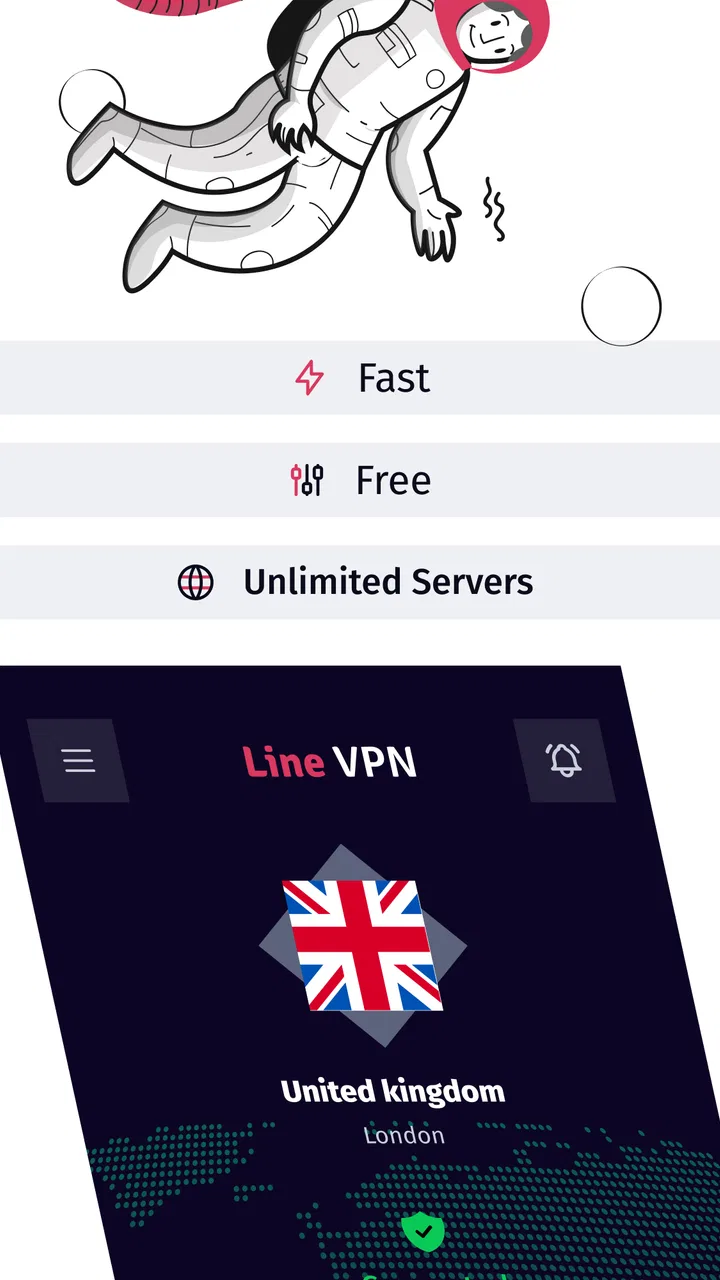
Line VPN
- 4.7
- Rating
- 1.00M
- Installs
- Free
- Price

 Analysis by App-foxy
When a VPN is going to be used on a shared phone or tablet, the important question is not only whether it connects quickly. I also want to know how clearly the setup can be managed, whether another person can understand what is happening, and whether the app fits the age and trust level of everyone using that device. I spent time with Line VPN from VRMN Tech with that kind of everyday use in mind. It is a free tools app for Android, presented with a simple focus on getting a VPN connection running without turning the process into a technical project.
My first impression is that Line VPN is aimed at people who want a straightforward privacy layer for ordinary browsing, public Wi-Fi, and travel. It is not presented as a complete household management system, and I would not treat it as one. Instead, its value comes from being easy to reach when a device needs a VPN connection. That makes it potentially useful on a shared device, provided the adults responsible for that device agree on when it should be enabled and who is allowed to change its settings.
Using Line VPN on a shared household device
A realistic example is a family tablet that moves between the kitchen, a teenager’s room, and occasional hotel stays. One person may use it for email, another for streaming or browsing, and someone else may connect it to unfamiliar Wi-Fi while traveling. In that situation, Line VPN can serve as a quick manual checkpoint: before using a network you do not fully trust, open the app and establish the VPN connection first.
You May Also Like

 Blood Strike: 2.5 Anniversary
Blood Strike’s Loadouts Turn Every Drop Into a Tactical Gamble
A close look at Blood Strike’s custom loadouts: how fast access to signature weapons reshapes its battle royale rhythm, rewards preparation, and narrows the gap between fights.

 Pandora - Music & Podcasts
Pandora’s Music Is Easy to Start, but Harder to Recover
Pandora’s strength is its low-effort path from a seed to a station. Its weak spot is how much confidence it asks you to place in connection, setup, and quiet recovery.

 8 Ball Pool
 Is Built on Rivalries, Rematches, and Routine
A close look at the rivalries, rematches, shared routines, and unanswered safety questions that turn a quick pool match into a persistent mobile community.

 Samsung Music
’s Quiet Strength Is Playing What You Already Own
Its reach comes less from spectacle than from dependable access to a personal library. That simplicity is both the app’s strongest retention engine and its ceiling.

 AccuWeather: Weather Radar
AccuWeather Review: A Quick, Clear Forecast for Everyday Decisions
For everyday plans, the best forecast is the one you can understand quickly. AccuWeather makes rain timing, radar, and local conditions easy to act on, with a few trade-offs.

 Hill Climb Racing
Why Hill Climb Racing Still Turns Crashes Into One More Run
A tiny car, a bumpy hill and one more upgrade: Hill Climb Racing keeps resurfacing because its simple chaos makes every near-miss feel personal.
More From Our News Desk



I like this workflow because it does not require every household member to understand networking. The person who manages the device can show the others one simple habit: check the VPN app before entering passwords or handling private information on public Wi-Fi. That is more useful than telling someone vaguely to “be careful online.” It turns privacy into a repeatable action.
There is also a practical limitation. A VPN app on a shared device does not automatically create separate privacy spaces for different people. If several users share the same Android profile, the app’s state and any connection choices belong to that device environment rather than to a carefully separated family account structure. I would therefore use it as a connection tool, not as a way to supervise browsing or divide household identities.
The app belongs in the VPN tools part of the Android ecosystem, and that distinction matters. Its job is to help route the device’s connection through a VPN service. It is not a replacement for screen-time settings, child-safety controls, password managers, antivirus software, or a household router configured by an experienced adult. Combining those tools may make sense, but Line VPN should not be expected to cover their responsibilities.
For a shared tablet, I would keep the app visible rather than burying it in a folder. That small choice helps younger or less technical users understand when the VPN is active and makes it easier to ask for help if the connection behaves differently. I would also agree on a household rule about disconnecting it when troubleshooting a website or app, then reconnecting it afterward. Without that routine, people may blame the VPN for a problem and quietly leave it disabled.
What the setup means for account boundaries
Line VPN does not change the fact that accounts belong to the services being accessed. A VPN connection can affect how a network sees traffic, but it does not merge family accounts, create separate profiles, or prevent one person from using another person’s already signed-in apps. That is why I would first organize the device itself: use separate Android profiles where available, avoid sharing passwords, and keep personal accounts signed out when the tablet changes hands.
This is one of the less obvious points about using any VPN in a household. People sometimes assume that turning on a privacy tool makes a shared device private for everyone. In practice, privacy has several layers. The VPN concerns the network path, while account separation concerns who can open an app, read saved information, or continue an existing session. Line VPN can be useful for the first layer, but it does not solve the second.
My preferred routine is to decide who controls installation and configuration, then let other users operate the connection without changing settings casually. On a family device, that reduces accidental experimentation. If a child needs the VPN for a school trip or a public hotspot, an adult can prepare the device beforehand and explain the visible steps without handing over every account credential.
There is a trade-off here between convenience and control. A single shared setup is quick, but it offers less separation. Separate device profiles are cleaner, though they require more organization and may not be practical on every tablet. Line VPN fits either arrangement as a connection utility, but the quality of the household boundary comes from the operating system and family habits around it.
Coordinating connection habits without confusion
In my experience, the best way to introduce a VPN to several people is to define a few situations instead of giving a long technical explanation. For example, use it before joining airport, hotel, café, or event Wi-Fi; leave it available during ordinary browsing if the connection remains comfortable; and temporarily disconnect only when diagnosing a compatibility issue. That gives each person a reason for the action.
Line VPN’s store summary emphasizes speed and security, and that is the right expectation to test in daily use rather than accept as a guarantee. A VPN can add another step between the device and the destination, so some websites or apps may respond differently. If a banking app, video service, or work portal refuses to load, I would not immediately assume the account is broken. I would compare the experience with the VPN off, then reconnect it once the task is complete.
This troubleshooting habit is especially important on a shared device because one person’s fix can become another person’s problem. If a parent disconnects the VPN to open a stubborn website and forgets to restore it, a teenager may later use the tablet on public Wi-Fi without realizing the protection changed. I would place a short reminder near the charging area or add a household rule that the person who changes the connection tells the next user.
Another useful practice is to check the device’s VPN indicator before sensitive tasks rather than relying only on memory. The app can be part of that check, while Android’s own status area provides a second visual cue. This is a simple but meaningful improvement over opening the VPN only when someone remembers that a network might be risky.
Line VPN is also easier to explain when I avoid promising anonymity. A VPN may reduce exposure on the local network, but it does not make a person invisible, remove tracking from every app, or protect against phishing. In a household, honest wording builds better trust: “This helps protect the connection” is more accurate than “Nobody can see anything.”
Age context, trust, and responsible use
The app carries an Everyone content rating, which makes its general presentation suitable for a broad audience. That does not mean every user should configure it without guidance. Age suitability and technical responsibility are different questions. A younger user may be perfectly capable of tapping the connection control but still need an adult to explain why a VPN is being used and what it does not protect.
I would introduce it to a child as a safety habit for networks, not as a way to bypass household rules, school policies, or service restrictions. That distinction matters because VPNs can be misunderstood as permission to ignore boundaries. In a family setting, the adult conversation should cover when the connection is expected, which accounts belong to whom, and what to do if an app behaves strangely.
Trust also works both ways. Parents may want to know whether a VPN is active, while older children may reasonably want privacy for their own accounts. Line VPN does not replace that conversation with an automatic family dashboard. If the household needs detailed activity reports, approved-app lists, or age-based web filtering, I would look for dedicated parental-control tools and keep the VPN’s role separate.
For teenagers, the app can be useful during travel or when using shared public networks, but I would pair it with lessons about fake login pages, reused passwords, and suspicious messages. A VPN cannot stop someone from voluntarily giving credentials to a scam site. This is a crucial limitation, and it is exactly why I would recommend Line VPN as one part of a digital-safety routine rather than the entire routine.
Older adults can benefit from the same simplicity, especially if they regularly connect a phone to unfamiliar wireless networks. The main challenge is making the status understandable. I would demonstrate the connection process in advance, leave the app easy to find, and explain what to do when a website becomes unavailable. A calm, repeatable explanation is more valuable than technical vocabulary.
Where Line VPN fits beside usual alternatives
The usual alternatives fall into several groups. Some people rely only on the security of a home network, while others use a browser’s private mode, a security suite with VPN functionality, or a subscription VPN with a larger set of controls. These options are not interchangeable. Private browsing can reduce local browser history but does not create a VPN connection. A home router may protect devices inside the house but does not automatically cover a phone on hotel Wi-Fi. A broader security suite may be convenient if you already pay for it, though it can add more menus and services than a casual user wants.
Line VPN makes the most sense for someone who wants a dedicated, free VPN app rather than a bundle. Its current version is 3.8, and it runs on Android 8.0 or later, which gives it a reasonably broad place on older compatible devices. I would still check the actual phone or tablet before planning a household rollout, particularly if the device is old or has unusual manufacturer software.
The app has attracted a 4.7 average from around 46 thousand ratings, with more than 8 thousand written reviews, and it has passed the million-install mark. Those figures suggest that it is not an obscure experiment, but popularity does not answer every practical question. A household should still judge it by connection reliability, ease of recovery when something fails, and whether everyone understands the boundaries.
Because it is free, Line VPN is attractive for a spare phone, a travel tablet, or a family member who does not want another subscription. The trade-off is that people who need advanced provider selection, detailed configuration, business support, or a carefully documented privacy policy may prefer a more specialized paid service. I would not choose this app solely because it costs nothing if the device is used for sensitive professional work or if the user needs precise control over every connection detail.
One non-obvious advantage of a dedicated app on a shared device is teachability. A bundled security product can be powerful but may hide the VPN behind a larger dashboard. Line VPN gives the household a single place to look when the goal is simply to establish or check a VPN connection. The drawback is that a focused tool may leave you needing separate solutions for malware protection, account safety, and family management.
Practical questions I would settle before installing it
The first question is whether it is suitable for an older Android device. Since the minimum requirement is Android 8.0, I would check the tablet’s software version before asking a family member to depend on it during travel. If the device is compatible, I would install it while connected to a trusted home network, test the basic connection, and show the intended users where to find it.
The second question is whether it can replace parental controls. My answer is no. It can help with the network connection, but it should not be treated as a child account system or a browsing monitor. Families that need those functions should configure Android’s available supervision tools or use a dedicated service alongside the VPN.
The third question is whether everyone on the device gets a separate VPN identity. I would not assume that. The safest household approach is to think in terms of the device’s active VPN connection and the Android user profile currently in use, not a set of automatically isolated family accounts. Keep personal logins separate through the operating system and the individual apps.
The fourth question is what to do when an app stops working. I would test the same task with the VPN temporarily disconnected, note whether the issue changes, and then reconnect it. If the problem persists, it is probably not sensible to keep toggling the VPN blindly. Check the device’s network connection and the affected service instead. This simple diagnosis prevents one user from changing settings repeatedly for everyone else.
The fifth question is whether a free app is enough for the whole household. For casual browsing, public Wi-Fi, and straightforward travel use, it may be a sensible starting point. For a workplace device, a person with strict privacy requirements, or a family that wants centralized administration, I would compare it with a service designed specifically for those needs.
My household verdict after using it
I see Line VPN as a practical entry point for families and shared-device users who want a visible, easy-to-explain VPN tool without paying for a bundle. Its strongest role is not complicated customization; it is helping people remember to protect a connection before using unfamiliar Wi-Fi. That is a modest goal, but it is useful when the app fits the device and the household understands what the VPN does.
I would recommend it to an adult setting up a travel phone, a shared tablet used on occasional public networks, or a family member who needs a simple privacy step and runs a compatible Android version. I would also recommend writing down the household rule for turning it on and explaining the difference between network privacy and account privacy. Those two minutes of coordination make the app much more effective.
I would skip it as the sole solution for a child’s online safety, a managed business fleet, or anyone demanding extensive controls and specialized support. In those cases, a more comprehensive security or VPN service may be the better choice. The same applies if the household cannot agree on who manages the settings, because a VPN that is repeatedly disabled or misunderstood will not deliver much practical value.
Overall, my view is positive but measured. The app is free, broadly accessible to compatible Android users, and backed by substantial user adoption. More importantly for a shared device, it can become a clear part of a household routine without pretending to solve every privacy or parenting problem. Use Line VPN as one layer in a well-organized device, not as a substitute for trust, account boundaries, or sensible online behavior.
FAQs for Line VPN
01What is Line VPN and how does it work?
Line VPN is a privacy and security application designed to create an encrypted connection between your device and the internet. After connecting to one of its available servers, your online traffic is routed through that server, which can help protect data when using public Wi‑Fi and reduce exposure of your IP address. It is important to remember that a VPN does not make you completely anonymous or protect you from every online threat.
02Is Line VPN free to use, or does it require a subscription?
Line VPN may offer a free version, but the available features can depend on the current app edition, region, and subscription plan. Free access may include limitations such as advertisements, fewer server locations, slower speeds, or restricted daily usage. Before downloading or starting a trial, check the app’s pricing page and store listing carefully, including renewal terms, trial duration, and whether subscriptions are managed through Google Play or the App Store.
03Does Line VPN keep logs of users’ online activity?
The answer depends on Line VPN’s current privacy policy and the specific service infrastructure used by the application. Before relying on it for sensitive browsing, review the policy for information about connection logs, IP addresses, browsing activity, device identifiers, and sharing with third parties. A VPN can encrypt traffic between your device and its server, but the provider may still be able to collect certain technical or account information.
04Can Line VPN unblock streaming services, websites, or restricted content?
Line VPN may allow access to content that is unavailable on a particular network or region by connecting through a different server location. However, this is not guaranteed for every website or streaming platform. Services frequently detect and block VPN addresses, and using a VPN may violate the terms of some providers. Performance can also vary depending on server distance, congestion, your connection, and whether the selected location supports the content you want.
05Will Line VPN slow down my internet or drain my battery?
Using Line VPN can affect connection speed because your traffic is encrypted and routed through an additional server. The impact is usually smaller when you choose a nearby, uncrowded location, while distant or busy servers may produce higher latency and slower downloads. The app can also use extra battery and mobile data while running in the background. Disconnecting when protection is unnecessary and enabling automatic connection only on untrusted networks may help.
Pros
- Simple setup with no technical configuration required
- Works across Android and iOS devices
- Encrypts traffic on unsecured public Wi‑Fi networks
- Can help reduce ISP and network-based tracking
- Useful for accessing region-specific online services while traveling
Cons
- Connection speeds may drop when routing traffic through distant servers
- Server locations and features may vary by subscription plan
- Some streaming platforms may detect and block VPN connections
- Requires trust in the provider’s privacy and logging practices
- A subscription may be needed for the most useful features

Line VPN
Gallery